
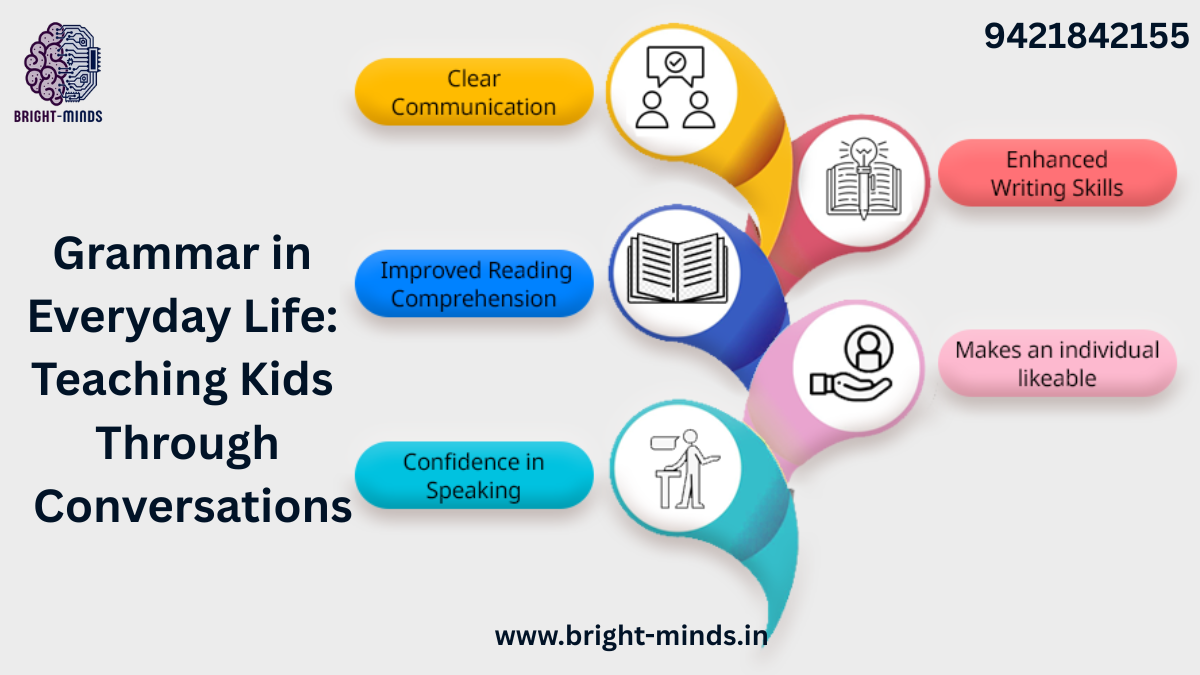
Grammar may feel like a rulebook full of confusing terms, but for kids, it can be much simpler—and much more fun. One of the most effective ways to teach language skills isn’t through worksheets or textbooks, but through natural conversations in everyday life. The goal is to help children understand grammar without feeling like they are studying. When kids learn grammar in context, they absorb concepts faster, remember better, and gain the confidence to communicate clearly.
In this blog, we explore how grammar in everyday life can become a natural part of a child’s learning journey. We’ll look at practical examples, modern learning trends, conversational techniques, and how parents, teachers, and even organizations can benefit from integrating grammar into daily interactions.
What Is Grammar in Everyday Life?
When we talk about grammar in everyday life, we refer to the grammar kids learn through regular communication—talking to parents, listening to teachers, interacting with friends, and observing the world around them. This natural learning environment introduces them to sentence structure, tenses, prepositions, articles, and more—without making grammar feel like a school subject.
For beginners, especially younger children, real-life grammar exposure is far more impactful compared to rote learning. Kids understand how language works by hearing it used correctly and consistently.
For example:
- When a parent says, “We are going to the park,” the child naturally understands the present continuous tense.
- When a teacher says, “Please place your bag on the table,” the child absorbs the correct use of prepositions.
- When siblings talk about what they did today, children absorb past tense structures without formal teaching.
This is why using grammar in everyday life is such a powerful learning tool.
Why Teaching Grammar Through Conversations Works
Conversations are the most natural learning method. Language existed long before grammar books did. Kids are wired to learn through observation and interaction, and conversational grammar fits directly into that instinctive learning style.
Here’s why this approach is so effective:
It feels natural, not forced
Kids don’t feel like they’re studying; they’re simply talking and listening. Grammar becomes a part of real communication.
It builds practical communication skills
Instead of memorizing rules, kids learn how grammar helps them express thoughts clearly.
It improves long-term retention
When grammar concepts are used repeatedly in conversations, they become instinctive.
It boosts confidence
Children who learn in a natural environment speak with more confidence because they aren’t afraid of making mistakes.
It encourages self-correction
By comparing what they hear with what they say, kids gradually learn to correct themselves.
How to Use Conversations to Teach Grammar
Now let’s explore practical conversational techniques that help kids learn grammar in everyday life.
Naming Objects and Actions
Children learn nouns and verbs simply by identifying objects and activities around them.
Example:
“That is your cup.”
“You are eating your food.”
“The dog is running.”
These simple lines help build vocabulary while teaching sentence patterns.
Using Tenses in Daily Routines
Daily routines provide perfect opportunities to teach tenses.
Morning (Future tense):
“We will go to school after breakfast.”
Evening (Past tense):
“You played so well today!”
Ongoing activities (Present continuous):
“You are drawing such a nice picture!”
Children understand tense changes naturally because they hear them in context.
Asking Simple Questions
Questions teach sentence structure, auxiliary verbs, and intonation.
Examples:
“Where is your book?”
“Do you want juice?”
“Why are you laughing?”
Asking questions encourages kids to respond, improving both grammar and speaking skills.
Introducing Prepositions through Actions
Kids understand prepositions best when they see them in action.
Examples:
“Put the toy under the pillow.”
“Come and sit beside me.”
“The cat is on the chair.”
This turns grammar rules into real-world understanding.
Encouraging Storytelling
Storytelling teaches sequence words like first, next, then, and finally.
Example:
“First we went to the shop, then we bought fruits, and finally we came home.”
Kids pick up how to structure information logically.
Correcting Mistakes Positively
Instead of saying, “That’s wrong,” model the correct sentence.
If a child says:
“I goed to school.”
Respond gently:
“Oh, you went to school? That sounds nice!”
This reinforces the correct grammar without discouraging the child.
Real-Life Game Activities for Grammar Learning
Games make grammar in everyday life even more engaging. Here are some fun activities:
Describe the Object
Take any object and describe its color, size, and use.
This builds adjectives and nouns.
Action Game
Say a verb, and the child performs the action.
“Jump, walk, clap, turn.”
Fix My Sentence
Say a funny, incorrect sentence.
“I am eating water.”
Kids love correcting it.
What Happened Today?
A simple past tense activity encouraging storytelling.
Grammar Learning in Modern Times: Trends and Tools
Parents and teachers today have more resources than ever to teach grammar naturally through conversations.
Voice Assistants
Kids often imitate Alexa, Google Assistant, and Siri. Clear, robotic language can support grammar learning.
Digital Reading Apps
Apps like StoryWeaver, Epic, and Amazon Kids provide sentence-rich reading experiences.
Interactive Classrooms
Modern classrooms encourage speaking, role play, and discussion—perfect for practicing grammar.
Video Content
Educational YouTube channels use simple, conversational grammar that kids easily absorb.
These trends show that grammar learning is shifting from textbooks to interactive, real-world use.
Applying Conversational Grammar in Companies and Training Programs
This blog also supports company employees, especially those working in training or communication roles. Organizations can use conversational grammar techniques to improve workplace communication.
In Customer Support
Teams learn to respond using clear, grammatically correct sentences.
In Email Writing
Conversational grammar helps simplify professional communication.
In Team Collaboration
Grammar improves clarity and reduces misunderstandings.
During Employee Onboarding
Trainers can demonstrate simple grammar rules through everyday conversations, making communication training more effective.
A Story: How Conversations Transformed One Child’s Grammar Skills
Six-year-old Rhea struggled with sentence formation. Her parents tried worksheets and grammar books, but nothing worked. Finally, her teacher suggested they start using simple conversations to teach grammar.
Every morning, her mother described actions like:
“You are packing your bag.”
“We will leave in ten minutes.”
“Did you finish your homework?”
Within a month, Rhea’s speech became clearer, her sentences became longer, and her confidence grew. She wasn’t learning grammar—she was living it.
This story reflects what many parents experience: grammar in everyday life is powerful.
Key Grammar Concepts Kids Learn Through Conversations
Sentence Formation
Kids learn how to form complete sentences with a subject and predicate.
Verb Tenses
Daily activities naturally teach past, present, and future tenses.
Prepositions
Actions and positions teach words like on, in, under, behind, beside.
Articles
Conversations introduce “a,” “an,” and “the” in context.
Pronouns
Kids understand “he,” “she,” “they,” “his,” and “her” by listening to others use them correctly.
Adjectives
Descriptions help kids understand colors, shapes, sizes.
Adverbs
Words like quickly, slowly, and happily appear naturally during conversations.
How to Integrate Grammar in Everyday Life: A Daily Routine Plan
Morning Routine
Use future tense and adjectives:
“We will leave soon.”
“It’s a beautiful sunny morning.”
Afternoon
Use present continuous and question forms:
“What are you making?”
“You are studying well.”
Evening
Use past tense:
“What did you learn today?”
“You cleaned your room nicely.”
This helps kids understand grammar throughout the day without structured lessons.
JSON-LD Structured DataYou may also like this:-