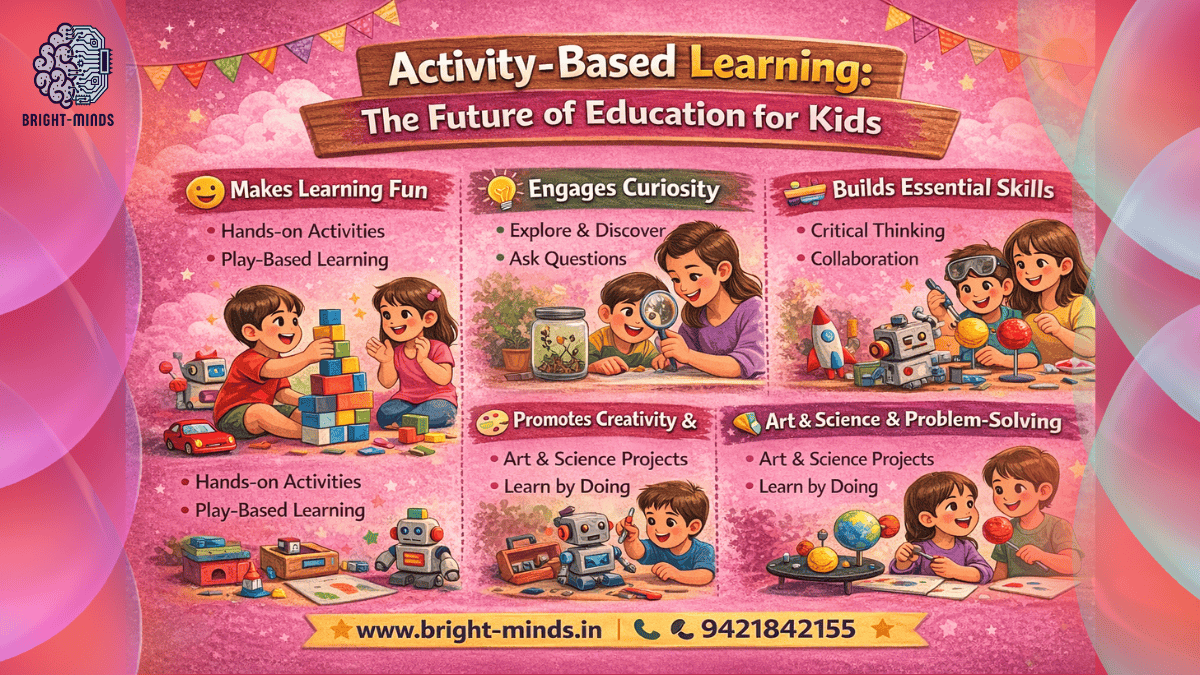
For decades, education followed a simple pattern: teachers explained, students listened, and exams tested memory. While this approach worked for some, it left many children disengaged, confused, or fearful of learning. Today, parents, educators, and organizations are realizing that the future belongs to activity-based learning for kids.
Children are naturally curious. They learn best not by memorizing answers, but by doing, exploring, and experiencing concepts firsthand. Activity-based learning shifts education from passive listening to active participation, making learning meaningful, enjoyable, and effective.
What Is Activity-Based Learning for Kids?
Activity-based learning for kids is an educational approach where children learn concepts through hands-on activities, real-life tasks, games, experiments, and group interactions rather than rote memorization.
Instead of only reading about a topic, children:
• Act it out
• Build it
• Experiment with it
• Discuss it
• Apply it in real situations
For example, learning math through shopping role-play or understanding science through simple experiments makes abstract ideas clear and memorable.
Why Activity-Based Learning Works Better Than Rote Learning
Traditional rote learning focuses on repetition. Activity-based learning focuses on understanding.
Here’s why activity-based learning for kids is more effective:
• Encourages critical thinking
• Improves retention and recall
• Builds confidence and communication
• Supports different learning styles
• Makes learning enjoyable
When children understand concepts deeply, they don’t just pass exams—they gain skills for life.
How the Brain Learns Through Activities
Neuroscience shows that children learn faster when multiple senses are involved. When kids see, hear, touch, speak, and move while learning, the brain forms stronger connections.
Activity-based learning activates:
• Cognitive skills (thinking, reasoning)
• Motor skills (movement, coordination)
• Social skills (teamwork, communication)
• Emotional skills (confidence, motivation)
This holistic development is what modern education demands.
Real-World Examples of Activity-Based Learning
Activity-based learning for kids can be easily applied at school and home.
Examples include:
• Learning vocabulary through storytelling and role play
• Understanding fractions using real food items
• Exploring geography with maps and models
• Practicing language through debates and presentations
• Learning science with simple household experiments
These activities turn lessons into experiences rather than lectures.
Benefits of Activity-Based Learning for Kids
The advantages go far beyond academics.
Key benefits include:
• Better understanding of concepts
• Improved problem-solving ability
• Enhanced creativity and imagination
• Strong communication skills
• Reduced fear of mistakes
• Higher engagement and curiosity
Children become active learners, not passive receivers.
Activity-Based Learning and 21st Century Skills
The world today values skills over marks. Activity-based learning for kids naturally develops essential 21st-century skills such as:
• Critical thinking
• Collaboration
• Creativity
• Communication
• Adaptability
These skills prepare children not only for exams but for future careers and real-life challenges.
Role of Teachers and Parents in Activity-Based Learning
Teachers act as facilitators rather than instructors. Parents become learning partners instead of pressure enforcers.
At home, parents can:
• Encourage learning through play
• Ask open-ended questions
• Support curiosity
• Celebrate effort over results
At school, educators design activities that allow children to explore, question, and discover knowledge independently.
Activity-Based Learning at Home: Simple Ideas
You don’t need expensive tools to apply activity-based learning for kids at home.
Simple ideas include:
• Cooking to learn measurements
• Storytelling to improve language skills
• Gardening to understand nature
• Board games to develop logic
• DIY crafts for creativity
Everyday activities become learning opportunities when guided thoughtfully.
Current Trends in Activity-Based Education
Education systems worldwide are rapidly adopting activity-based learning.
Key trends include:
• Experiential learning programs
• Project-based learning
• STEAM activities
• Gamified learning
• Interactive digital tools
Schools and learning centers now focus on how children learn, not just what they learn.
Activity-Based Learning in Corporate and Professional Training
Interestingly, activity-based learning is not limited to kids. Many companies now use the same principles for employee training.
Workshops, simulations, role-plays, and real-world projects help employees:
• Learn faster
• Retain knowledge longer
• Apply skills effectively
This shows how powerful and universal this learning method truly is.
Common Myths About Activity-Based Learning
Some people believe activity-based learning means no discipline or structure. This is incorrect.
In reality:
• Activities are goal-oriented
• Learning outcomes are planned
• Discipline is guided, not forced
• Assessment focuses on understanding
Structured activities create focused and meaningful learning environments.
Measuring Success in Activity-Based Learning
Success is not measured only by marks.
Look for:
• Improved confidence
• Better communication
• Logical thinking
• Willingness to participate
• Ability to apply concepts
These indicators reflect true learning progress.
Challenges and How to Overcome Them
Like any system, activity-based learning has challenges:
• Time management
• Curriculum alignment
• Teacher training
Solutions include:
• Proper planning
• Blended learning approaches
• Gradual implementation
When implemented thoughtfully, benefits far outweigh challenges.
Why Activity-Based Learning Is the Future of Education
The future demands thinkers, creators, and problem-solvers—not memorization experts.
Activity-based learning for kids:
• Aligns with modern education needs
• Builds lifelong learning habits
• Supports emotional and social growth
• Makes education meaningful
As education evolves, this approach is no longer optional—it’s essential.
Conclusion: Learning That Truly Lasts
Activity-based learning for kids transforms education from a task into a journey. When children learn by doing, they understand deeply, remember longer, and grow confidently.
By embracing activity-based methods at school and home, we prepare children not just for exams, but for life.
The future of education is active, engaging, and child-centered—and it starts today.
you may be interested in this blog here:-
Numeracy Skills for Pre-Primary Building a Strong Foundation
Learning Geography with Maps: A Kid’s Adventure Around the World