Creative writing has always been one of the most powerful tools to develop a child’s imagination, language skills, and confidence. Today, with the rise of artificial intelligence, a new opportunity has emerged—creative writing for kids using AI prompts. When used safely and under guidance, AI can become a creative companion that inspires children rather than replacing their thinking.
Parents, teachers, and even education-focused companies are now exploring how AI prompts can help children overcome writer’s block, structure stories, and enjoy writing without pressure. This blog is designed for beginners and educators who want to understand how AI can support creative writing for kids in a safe, ethical, and meaningful way.
Understanding Creative Writing for Kids Using AI Prompts
Creative writing for kids using AI prompts means providing children with simple, age-appropriate story starters, ideas, or questions generated by AI. These prompts act as a spark, not a solution. The child remains the storyteller, while AI only helps begin the journey.
For example, instead of asking a child to “write a story,” an AI prompt might say:
“Imagine a talking tree that protects a secret village. What happens when someone discovers it?”
This approach removes fear, boosts curiosity, and helps children focus on imagination rather than perfection.
Why Creative Writing Matters in Early Learning
Creative writing is not just about stories. It helps children develop multiple essential skills such as vocabulary building, emotional expression, critical thinking, and logical sequencing of ideas.
When children write creatively, they learn to express feelings, explore problem-solving, and communicate clearly. In classrooms and learning centers, creative writing has long been used to support language development. AI prompts simply modernize this process by making it more engaging and accessible.
How AI Prompts Support Children Without Replacing Creativity
A common concern is whether AI will make children lazy or dependent. The reality is quite the opposite when AI is used correctly. AI prompts do not write the story for the child. They only guide the starting point.
Think of AI as a friendly teacher asking the first question. The child answers with their imagination, emotions, and experiences. This balance ensures creativity stays human while technology remains supportive.
For example, an AI prompt may suggest a character and a setting, but the child decides the plot, dialogue, and ending. This keeps originality intact.
Safe and Guided Use of AI for Kids
Safety is the most important part of creative writing for kids using AI prompts. AI should never be used without boundaries, especially for young learners.
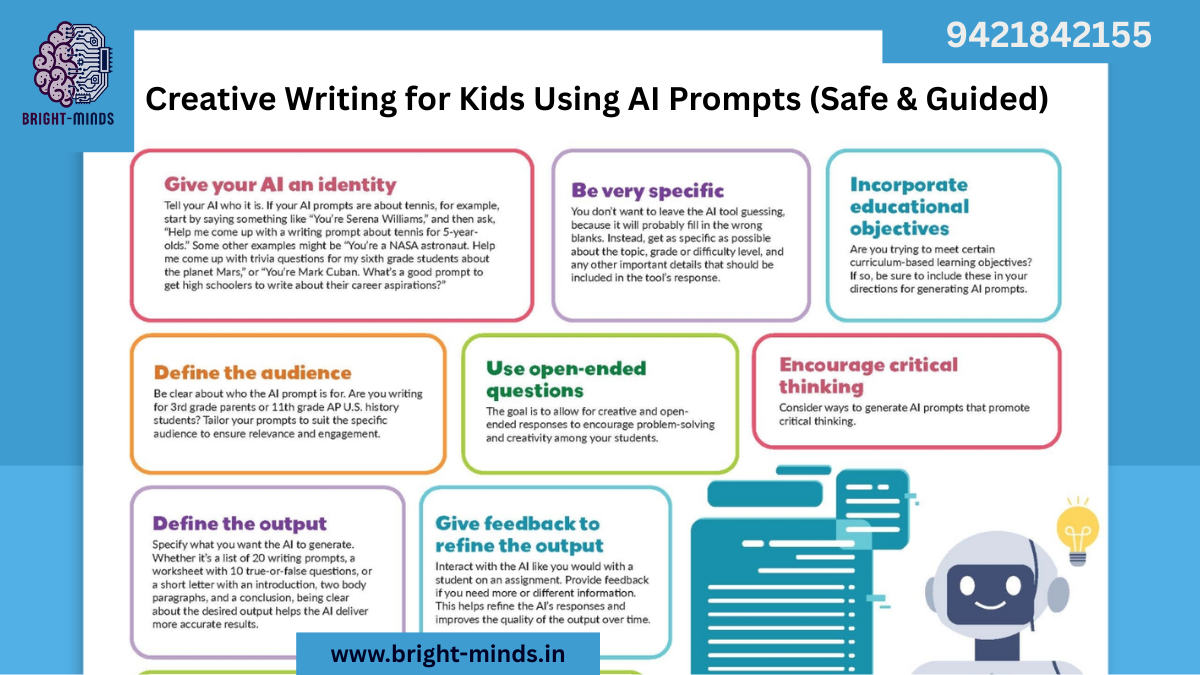
Safe usage includes adult supervision, predefined prompt libraries, age-appropriate language, and clear instructions that AI is a helper, not a replacement. Many educators create their own prompt lists inspired by AI but reviewed by humans.
Parents and teachers should encourage children to think, question, and expand beyond the prompt rather than copy responses. This ensures ethical and responsible use of AI in education.
Practical Examples of AI Writing Prompts for Kids
To understand how this works in real life, here are a few safe and guided examples:
Story Starter Prompt
“Once upon a time, a small robot found something unexpected in a school bag. What was it, and how did it change the robot’s life?”
Emotion-Based Prompt
“Write about a day when your favorite toy felt lonely. What happened next?”
Problem-Solving Prompt
“A village has lost its colors. One child discovers a way to bring them back. How?”
These prompts help children think deeply while enjoying the storytelling process.
Benefits for Parents, Teachers, and Learning Companies
Creative writing for kids using AI prompts is not just useful at home. Schools, coaching centers, and education startups can use this approach to design engaging writing programs.
For parents, it reduces resistance to writing practice. For teachers, it saves planning time while increasing participation. For companies, it opens opportunities for AI-powered learning tools that focus on creativity rather than automation.
Many modern education platforms now combine storytelling, AI prompts, and human feedback to deliver better learning outcomes.
Current Trends in AI-Based Creative Learning
One major trend in education is guided AI learning instead of unrestricted AI access. Platforms are shifting toward “human-in-the-loop” models where AI suggests ideas, and humans validate outcomes.
Another trend is prompt-based learning, where children learn how to ask better questions and build stories step by step. This improves thinking skills and digital literacy.
AI is also being used to personalize prompts based on age, reading level, and interests, making creative writing more inclusive and effective.
How to Introduce AI Prompts to Kids Step by Step
Start small. Introduce AI prompts as a fun game, not a rule. Sit with the child and discuss the prompt before writing begins.
Encourage brainstorming, drawing, or speaking ideas aloud before putting words on paper. After writing, ask the child to explain their story. This reflection strengthens learning.
Gradually, children become more confident writers who use AI prompts as inspiration rather than dependence.
One common mistake is letting AI generate full stories for kids. This removes creativity and learning value. Another mistake is using complex prompts that confuse or overwhelm young minds.
Always keep prompts simple, open-ended, and age-appropriate. The goal is imagination, not technical perfection.
Conclusion: A Balanced Future of Creativity and Technology
Creative writing for kids using AI prompts represents the future of learning when done responsibly. It blends imagination with modern tools, helping children express ideas confidently while staying creative.
When guided by parents, teachers, and educators, AI becomes a powerful ally rather than a distraction. Children learn not just how to write, but how to think, imagine, and communicate.
You may also like this:-