Early Learning Skills Before Grade 3: A Complete Beginner’s Guide
The early years of a child’s education are not just about finishing textbooks or scoring marks. They are about building a strong foundation that supports all future learning. Research across education and child development shows that early learning skills before Grade 3 play a critical role in a child’s academic success, emotional stability, and confidence later in life.
By the time a child reaches Grade 3, their brain has already developed most of its core learning pathways. This is why educators, parents, and even corporate learning specialists now emphasize foundational skills over rote memorization. Whether you are a parent, teacher, school administrator, or education company employee, understanding early learning skills before Grade 3 is essential.
Let’s explore what these skills are, why they matter, and how they can be developed effectively in today’s fast-changing learning environment.
Understanding Early Learning Skills Before Grade 3
Early learning skills before Grade 3 refer to a combination of cognitive, language, social, emotional, and physical abilities that children typically develop from ages 3 to 8. These skills help children understand the world, express ideas, solve problems, and interact with others.
Unlike advanced academic topics, these skills focus on “learning how to learn.” A child who masters early learning skills before Grade 3 finds it easier to read fluently, understand math concepts, follow instructions, and manage emotions in higher classes.
Why Early Learning Skills Before Grade 3 Are So Important
Education experts often say, “Grade 3 is a turning point.” This is because children transition from learning basic skills to using those skills to learn new subjects.
Children who lack strong early learning skills before Grade 3 may struggle with:
- Reading comprehension
- Basic math operations
- Classroom behavior
- Self-confidence
- Attention and focus
On the other hand, children with strong foundations become independent learners. They ask questions, explore ideas, and adapt easily to new challenges.
From a professional education standpoint, early intervention reduces learning gaps, improves long-term outcomes, and lowers the need for remedial education later.
Core Early Learning Skills Before Grade 3
Let’s break down the most important early learning skills before Grade 3 into practical categories.
Language and Communication Skills
Language development is one of the most critical early learning skills before Grade 3. It includes speaking, listening, reading readiness, and writing basics.
Children should be able to:
- Express thoughts clearly
- Understand instructions
- Recognize letters and sounds
- Build vocabulary
- Form simple sentences
For example, when a child can narrate a short story about their day, they are not just talking—they are organizing thoughts, recalling events, and practicing communication.
Current trend: Phonics-based learning and storytelling activities are now widely used because they strengthen reading and speaking together.
Early Reading and Literacy Skills
Reading does not start with books alone. It begins with sound recognition, letter awareness, and curiosity.
Key literacy skills include:
- Identifying letter sounds
- Recognizing common words
- Understanding rhymes and patterns
- Following text from left to right
Children who develop strong early learning skills before Grade 3 in literacy are more likely to become confident readers. This directly impacts performance in all subjects, including science and social studies.
Practical use case: Daily reading routines, picture books, and guided reading sessions help children naturally develop literacy skills.
Foundational Math and Number Sense
Math at an early age is not about complex formulas. It’s about understanding numbers, patterns, and logic.
Important math-related early learning skills before Grade 3 include:
- Counting and number recognition
- Understanding more and less
- Simple addition and subtraction
- Recognizing shapes and patterns
For instance, when children count toys while playing, they are learning math through real-life experience.
Industry insight: Activity-based math learning using games and visual tools is replacing traditional memorization methods.
Cognitive and Thinking Skills
Cognitive development refers to how children think, reason, and solve problems. These early learning skills before Grade 3 prepare children to handle academic and real-world challenges.
Key cognitive skills include:
- Memory and recall
- Logical thinking
- Attention span
- Decision-making
Puzzle-solving, sorting activities, and “why” questions are powerful ways to develop cognitive skills.
In modern education systems, inquiry-based learning is gaining popularity because it encourages children to think independently.
Social and Emotional Skills
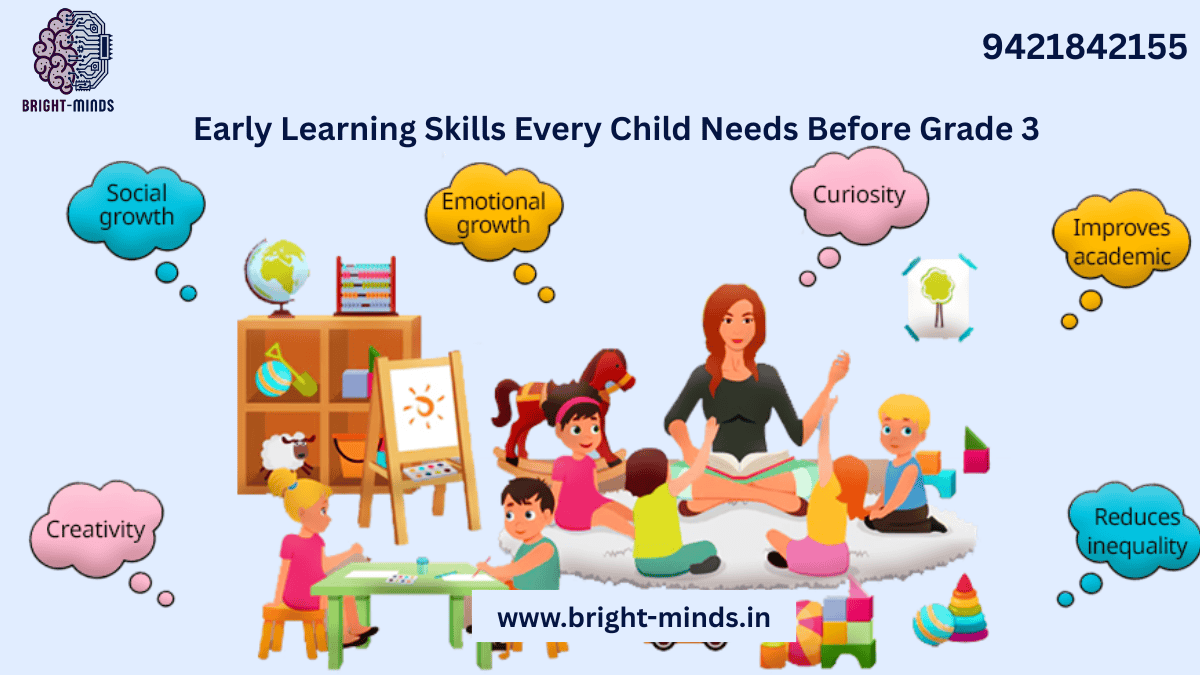
Academic success is incomplete without emotional intelligence. Social and emotional development is one of the most overlooked early learning skills before Grade 3.
Children should learn to:
- Share and cooperate
- Express emotions appropriately
- Build empathy
- Handle frustration
A child who can manage emotions performs better academically and socially.
Real-world example: Group activities and role-playing games teach teamwork, patience, and communication naturally.
Physical development supports writing, reading, and classroom participation.
Fine motor skills include:
- Holding a pencil
- Cutting with scissors
- Drawing shapes
Gross motor skills include:
- Running and jumping
- Balance and coordination
Strong motor skills enhance confidence and classroom engagement. Many modern early education programs integrate movement-based learning to support brain development.
Digital Awareness and Learning Skills
In today’s world, digital exposure starts early. Teaching healthy and guided digital habits is now part of early learning skills before Grade 3.
Children should learn:
- Basic device handling
- Following instructions in digital tools
- Using educational apps safely
The focus is not screen time, but purposeful digital learning that supports creativity and problem-solving.
Role of Parents and Educators in Building Early Learning Skills
Developing early learning skills before Grade 3 is a shared responsibility.
Parents can:
- Read daily with children
- Encourage questions
- Create learning routines at home
Educators can:
- Use activity-based teaching
- Observe individual learning styles
- Provide positive feedback
Education companies and training institutes are now designing structured early learning programs that align with child psychology and modern teaching standards.
Common Mistakes to Avoid
While focusing on early learning skills before Grade 3, it’s important to avoid:
- Excessive pressure
- Comparing children
- Ignoring emotional needs
- Relying only on marks
Learning should feel safe, engaging, and meaningful.
How Strong Early Learning Skills Impact Long-Term Success
Children with strong early learning skills before Grade 3:
- Perform better academically
- Adapt easily to change
- Develop leadership qualities
- Build lifelong learning habits
From schools to corporate learning environments, foundational skills are now recognized as the backbone of success.
Final Thoughts
Early learning skills before Grade 3 are not optional—they are essential. They shape how a child learns, thinks, communicates, and grows. Investing time and resources during these years creates confident learners who are prepared for both academic challenges and life skills.
Whether you are a parent, educator, or part of an education-focused organization, now is the best time to strengthen early learning foundations.