
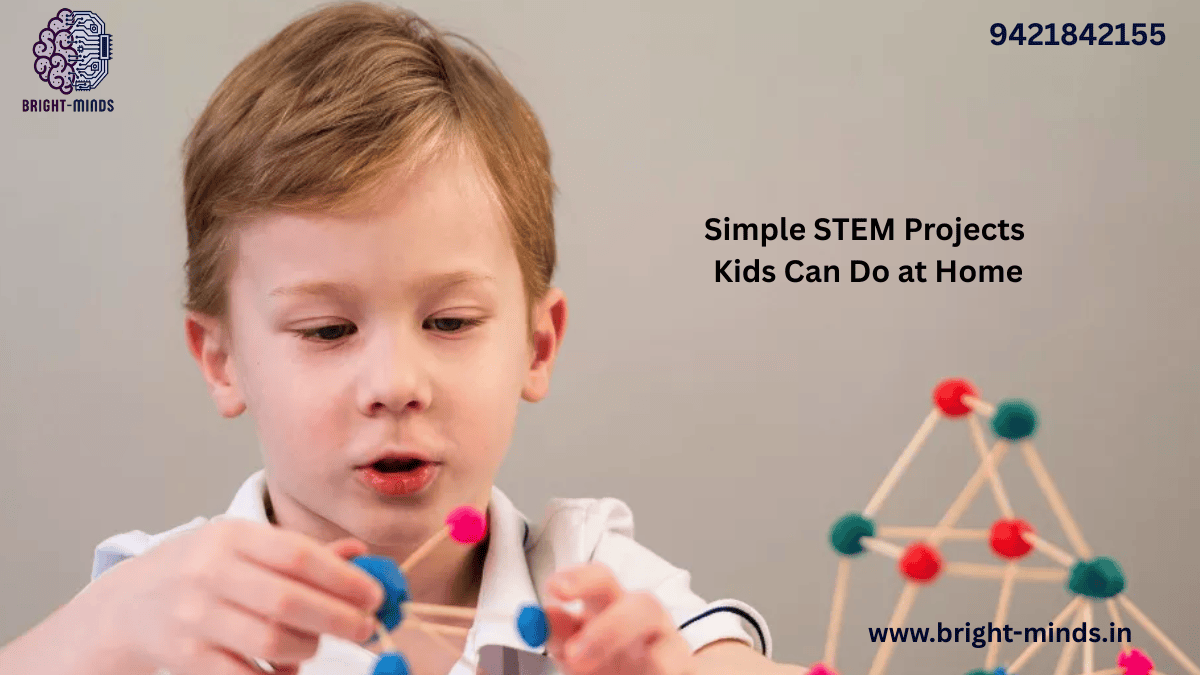
Simple STEM Projects Kids Can Do at Home
Children are naturally curious. They love asking questions, exploring new ideas, and experimenting with the world around them. STEM education which focuses on science technology engineering and mathematics helps nurture that curiosity and turn it into meaningful learning. While many people associate STEM with classrooms and laboratories, some of the most exciting learning experiences can happen right at home.
Simple STEM projects allow children to explore scientific concepts through hands on activities using everyday materials. These projects encourage kids to think critically, solve problems, and discover how things work. Most importantly they make learning fun and engaging rather than feeling like traditional schoolwork.
Parents do not need advanced scientific knowledge or expensive equipment to introduce STEM learning at home. With a little creativity and guidance, everyday household items can become tools for exciting experiments and discoveries. This guide explores simple STEM projects that children can enjoy while developing valuable skills that support learning and innovation.
Why STEM Projects Are Important for Children
STEM activities help children develop skills that are essential for both academic success and real world problem solving. When kids engage in hands on experiments they begin to understand how scientific ideas connect with everyday life.
One of the biggest benefits of STEM projects is the development of critical thinking. Instead of simply memorizing information children learn to ask questions, make predictions, test ideas, and observe results. This process encourages deeper understanding and curiosity.
STEM projects also build creativity. Many experiments require children to design solutions, build structures, or invent new ways to complete tasks. These activities combine imagination with logical thinking.
Another advantage is confidence. When children successfully complete a project or discover the reason behind an experiment, they feel proud of their achievements. This sense of accomplishment encourages them to continue exploring and learning.
Preparing a STEM Friendly Environment at Home
Before beginning STEM projects it helps to create a learning environment that encourages exploration and creativity. A simple table or workspace with basic supplies can serve as a mini discovery lab.
Common materials such as paper cups, plastic bottles, baking soda, vinegar, straws, tape, rubber bands, and cardboard are perfect for many beginner experiments. Keeping these supplies in a small box allows children to easily access them during activities.
Parents should also encourage curiosity by asking questions and allowing children to share their observations. Instead of providing all the answers immediately, guide children to think about what might happen and why.
This supportive environment helps children view STEM activities as exciting opportunities to explore rather than strict assignments.
Build a Baking Soda Volcano
One of the most popular STEM projects for kids is the baking soda volcano. This classic experiment introduces children to simple chemical reactions while creating a fun visual effect.
To begin, shape a small volcano using clay or mold it around a plastic bottle placed on a tray. Fill the bottle with a few spoonfuls of baking soda. Add a little dish soap and a few drops of food coloring to create a colorful eruption.
When vinegar is poured into the bottle the mixture produces bubbling foam that flows out like lava.
This reaction happens because baking soda and vinegar create carbon dioxide gas when combined. The gas forms bubbles which push the mixture out of the bottle.
Children can repeat the experiment while adjusting the amounts of ingredients to observe how the eruption changes.
Create a Balloon Powered Car
Engineering projects help children understand motion and energy. A balloon powered car is a simple activity that demonstrates how air pressure can create movement.
Start by building a small car using cardboard or a lightweight plastic container. Attach four bottle caps as wheels using wooden skewers or straws as axles.
Tape a balloon to the top of the car with a straw inserted into the balloon opening. When the balloon is inflated and released the escaping air pushes the car forward.
Children quickly see how the force of the air creates motion. They can experiment with different balloon sizes or car designs to see which version travels the farthest.
This project encourages problem solving and introduces basic engineering concepts.
Grow Crystals with Sugar or Salt
Crystal growing experiments are a fascinating way to explore chemistry and patience. Children can create crystals using sugar or salt dissolved in hot water.
Begin by heating water and mixing in sugar or salt until the liquid becomes highly concentrated. Pour the solution into a clear jar and suspend a string or wooden stick into the liquid.
Over several days crystals begin to form on the string as the water slowly evaporates.
Children learn how dissolved substances can return to solid form when conditions change. Observing the gradual crystal growth also teaches patience and careful observation.
Build a Paper Bridge
Engineering challenges encourage children to think creatively about structures and stability. Building a paper bridge is a simple project that demonstrates how design affects strength.
Provide children with sheets of paper and ask them to create a bridge that can support weight. They can fold, roll, or layer the paper in different ways.
Once the bridge is built place small objects such as coins or books on top to test its strength.
Children quickly learn that certain shapes such as folded arches or layered structures provide greater support. This project introduces basic engineering principles while encouraging experimentation.
Make a Simple Water Filter
Water filtration experiments help children understand environmental science and the importance of clean water.
To create a simple filter use a plastic bottle cut in half. Turn the top portion upside down like a funnel and place it into the bottom half of the bottle.
Layer materials such as cotton balls, sand, small stones, and charcoal inside the funnel. Slowly pour dirty water through the filter and observe how the layers remove particles.
While the filtered water may not be safe for drinking, the experiment clearly demonstrates how natural materials can help clean water.
This activity encourages discussions about environmental protection and the importance of water purification.
Build a Homemade Compass
Magnetism is an interesting scientific concept that children can explore through a simple compass project.
Magnetize a sewing needle by rubbing it several times with a magnet. Then carefully place the needle on a small piece of floating cork or foam in a bowl of water.
The needle will gradually align itself in a north south direction due to the Earth magnetic field.
Children can compare the needle direction with a real compass to see how closely they match.
This experiment introduces geography and physics concepts while showing how simple tools can help with navigation.
Create a Rain Cloud in a Jar
Weather experiments help children understand natural processes in the atmosphere. A rain cloud in a jar is a fun project that demonstrates how precipitation forms.
Fill a clear jar with water and add a layer of shaving cream on top to represent a cloud. Slowly drop colored water onto the shaving cream using a dropper.
As the colored water accumulates it eventually falls through the shaving cream into the jar like rain.
This activity visually explains how clouds become heavy with moisture before releasing rain.
Children can experiment with different amounts of colored water to observe how quickly the rain effect occurs.
Design a Straw Tower
Building challenges help children practice engineering skills and teamwork. A straw tower activity involves constructing the tallest or strongest tower using only drinking straws and tape.
Children must think carefully about structure and balance while designing their tower. Some may create triangular bases while others build wider foundations.
Testing the tower strength by adding small objects encourages children to evaluate and improve their designs.
This activity develops creativity, planning, and problem solving abilities.
Encourage Curiosity Through Questions
STEM learning becomes even more effective when children are encouraged to ask questions. Parents can guide discussions during experiments by asking what children think will happen before the project begins.
After completing the activity ask what they observed and whether the results matched their predictions.
These conversations help children connect their actions with scientific reasoning and develop stronger analytical skills.
Allow Room for Experimentation
One of the most valuable aspects of STEM projects is the freedom to experiment. Not every project will work perfectly the first time, and that is part of the learning process.
Encourage children to try new ideas, adjust materials, and explore different solutions. These experiences teach persistence and creativity while reinforcing the scientific method of testing and observation.
Children often discover their own improvements to projects when given the opportunity to explore independently.
Making STEM a Regular Family Activity
STEM projects can become a fun family tradition rather than an occasional experiment. Setting aside time each week for a new project keeps children excited about learning.
Parents can rotate activities between science experiments, engineering challenges, and simple technology projects.
This variety keeps children engaged while exposing them to different areas of STEM learning.
Family participation also makes the experience more memorable and encourages collaboration.
Long Term Benefits of STEM Learning at Home
Children who regularly engage in STEM activities develop valuable skills that extend far beyond individual experiments. They become curious thinkers who enjoy solving problems and exploring new ideas.
These skills support academic success and prepare children for future careers in science, technology, engineering, and many other fields.
STEM learning also strengthens creativity and resilience. Children learn that challenges can be solved through experimentation and thoughtful thinking.
You may also like this:-